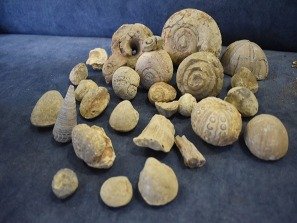
Fossils

Geo Treasures Nexus – Preserving the Past, Educating the Future
Fossils are more than remnants of ancient organisms—they are archives of Earth’s dynamic history and pillars of geoheritage conservation. Through research, education, and academic collaboration, Geo Treasures Nexus bridges scientific discovery with responsible stewardship of Earth’s natural legacy.
Fossils: Preserving the Record of Ancient Life
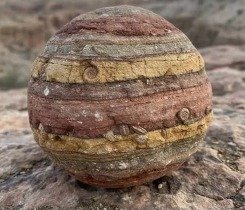
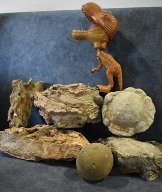
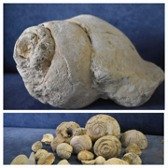
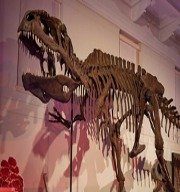
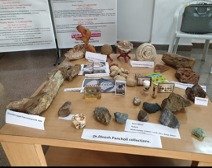
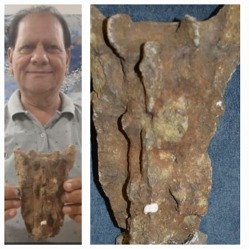
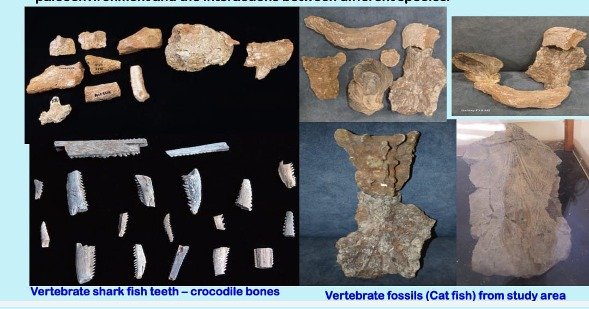
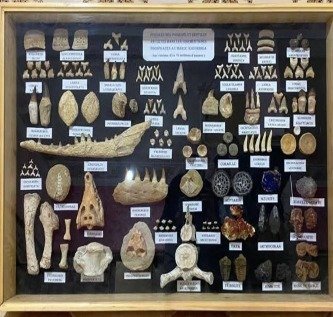
Fossils are remarkable natural archives that preserve evidence of life that existed on Earth millions of years ago. They provide invaluable insights into biological evolution, ancient environments, climatic conditions, and geological history. At Geo Treasures Nexus, fossils are presented not only as scientific specimens but also as vital components of Earth’s geoheritage and natural legacy.
Definition of Fossils
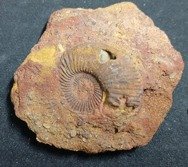
A fossil is the preserved remain, impression, or trace of ancient plants, animals, or microorganisms embedded within rocks, typically sedimentary formations. Fossilization occurs through natural geological processes such as mineral replacement, burial, compression, or preservation in sediments over geological time scales.
Fossils act as historical records that help scientists reconstruct past ecosystems and understand the development of life on Earth.
Major Types of Fossils
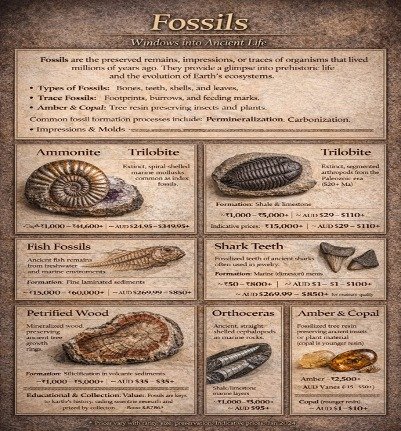
Types of Fossils
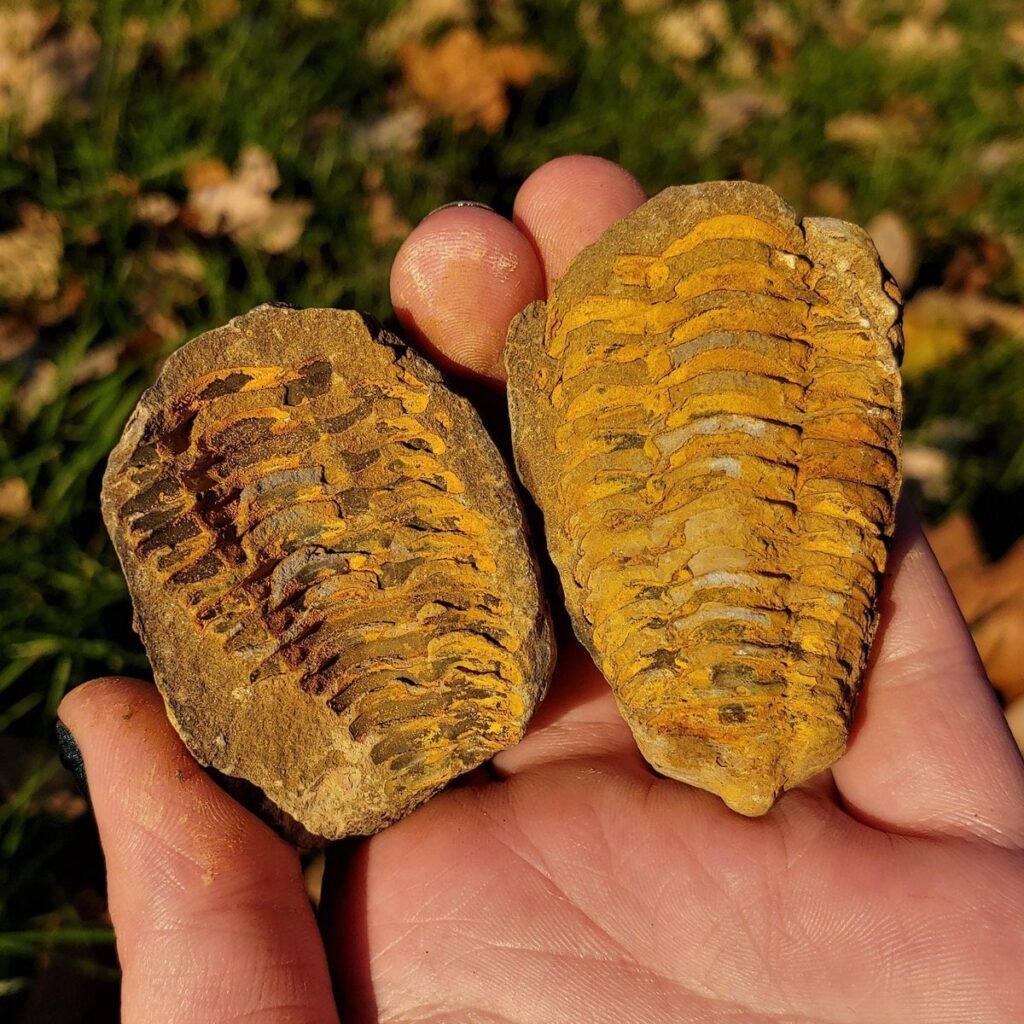
1. Body Fossils
These include preserved physical remains of organisms such as bones, teeth, shells, wood, or leaves.
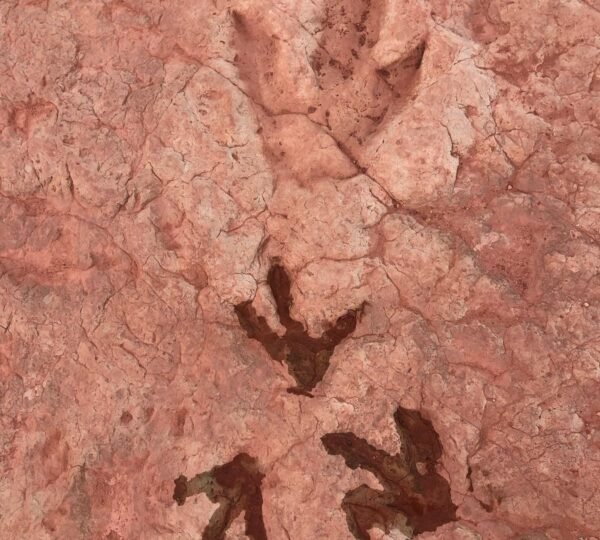
2. Trace Fossils (Ichnofossils)
Evidence of biological activity rather than the organism itself, including footprints, tracks, burrows, feeding marks, and coprolites (fossilized dung).
3. Mold and Cast Fossils
• Molds form when an organism leaves an impression in sediment.
• Casts develop when minerals fill these impressions, reproducing the organism’s shape.
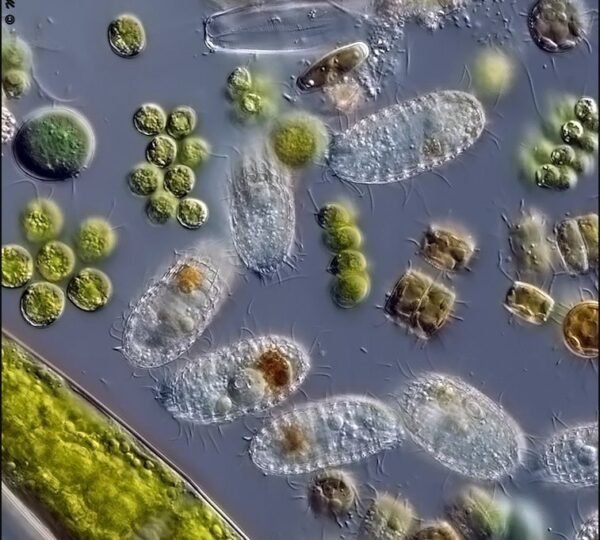
4. Microfossils
Microscopic remains of pollen, spores, plankton, or microorganisms, essential in petroleum geology and stratigraphic studies.
5. Petrified Fossils
Organic materials replaced by minerals, preserving detailed internal structures, such as petrified wood.
Importance of Fossils
Fossils play a crucial role in understanding Earth and life sciences:
• Provide evidence of biological evolution and extinction events.
• Help reconstruct ancient climates and environments.
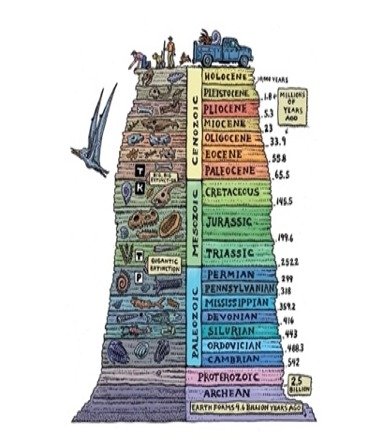
• Assist in dating and correlating rock layers (biostratigraphy).
• Support exploration of coal, petroleum, and mineral resources.
• Enhance scientific education and public awareness of Earth history.
Fossils connect geological time with biological development, making them essential tools for researchers and educators.
Fossils as Geoheritage
Fossils form an essential part of geoheritage, representing Earth’s biological and geological evolution. Fossil-bearing sites are natural heritage assets that require conservation and responsible management. Protecting fossil localities promotes scientific research, education, and sustainable geo-tourism while preserving Earth’s deep-time history.
These include preserved physical remains of organisms such as bones, teeth, shells, wood, or leaves.
Evidence of biological activity rather than the organism itself, including footprints, tracks, burrows, feeding marks, and coprolites (fossilized dung).
• Molds form when an organism leaves an impression in sediment.
• Casts develop when minerals fill these impressions, reproducing the organism’s shape.
Microscopic remains of pollen, spores, plankton, or microorganisms, essential in petroleum geology and stratigraphic studies.
Organic materials replaced by minerals, preserving detailed internal structures, such as petrified wood.
Importance of Fossils
Fossils play a crucial role in understanding Earth and life sciences:
• Provide evidence of biological evolution and extinction events.
• Help reconstruct ancient climates and environments.
• Assist in dating and correlating rock layers (biostratigraphy).
• Support exploration of coal, petroleum, and mineral resources.
• Enhance scientific education and public awareness of Earth history.
Fossils connect geological time with biological development, making them essential tools for researchers and educators.
Fossils as Geoheritage
Fossils form an essential part of geoheritage, representing Earth’s biological and geological evolution. Fossil-bearing sites are natural heritage assets that require conservation and responsible management. Protecting fossil localities promotes scientific research, education, and sustainable geo-tourism while preserving Earth’s deep-time history.
At Geo Treasures Nexus, fossils are celebrated as storytellers of ancient worlds—linking science, heritage, education, and conservation to inspire curiosity about our planet’s past.
Importance of Fossils
Fossils play a crucial role in understanding Earth and life sciences:
• Provide evidence of biological evolution and extinction events.
• Help reconstruct ancient climates and environments.
• Assist in dating and correlating rock layers (biostratigraphy).
• Support exploration of coal, petroleum, and mineral resources.
• Enhance scientific education and public awareness of Earth history.
Fossils connect geological time with biological development, making them essential tools for researchers and educators
Fossils & Geoheritage
Fossil-bearing formations represent valuable geoheritage sites, preserving Earth’s natural history. These sites:
• Showcase evolutionary milestones
• Promote geo-tourism and scientific awareness
• Require conservation and ethical collection practices
• Serve as outdoor laboratories for education and research
Protecting fossil geoheritage ensures that future generations can study and appreciate Earth’s ancient life.
Geo Treasures Nexus promotes responsible fossil documentation, preservation, and public education to safeguard geological heritage.
At Geo Treasures Nexus, fossils are celebrated as storytellers of ancient worlds—linking science, heritage, education, and conservation to inspire curiosity about our planet’s past.
Academic & University Support
Geo Treasures Nexus actively supports academic excellence by:
• Assisting students with M.Sc., Ph.D., and research theses
• Providing fossil identification guidance and stratigraphic interpretation
• Supporting field training and documentation
• Offering educational PPT resources and reference materials
• Encouraging university collaborations and research publications
Our fossil collections and knowledge resources serve as valuable tools for paleontology, stratigraphy, environmental geology, and Earth science programs.
Common Types of Minerals
Minerals are essential natural resources that support industrial development, construction, agriculture, and modern technology. Below are some of the most commonly found and widely used minerals.
Quartz
Quartz is one of the most abundant and durable minerals found in the Earth’s crust. It has a hard, glassy appearance and is highly resistant to chemical weathering.
Uses of Quartz:
- Manufacturing glass and optical lenses
- Electronics and semiconductor industries
- Watches, clocks, and scientific instruments
Feldspar
Feldspar is a group of minerals that make up a large portion of the Earth’s crust. It is commonly found in igneous and metamorphic rocks.
Uses of Feldspar:
- Ceramic and pottery industries
- Glass manufacturing
- Industrial fillers and abrasives
Mica
Mica is easily recognized by its shiny appearance and ability to split into thin, flexible sheets. It is an excellent insulator.
Uses of Mica:
- Electrical and thermal insulation
- Cosmetics, paints, and coatings
- Construction materials
Calcite
Calcite is a widely distributed mineral, especially in sedimentary rocks such as limestone. It reacts easily with weak acids, which helps in its identification.
Uses of Calcite:
- Cement and lime production
- Building stones and decorative materials
- Agricultural soil treatment
Halite
Halite, commonly known as rock salt, forms when seawater evaporates, leaving behind salt crystals. It is essential for both human consumption and industrial use.
Uses of Halite:
- Food seasoning and preservation
- De-icing roads in cold regions
- Chemical and pharmaceutical industries
Gypsum
Gypsum is a very soft mineral that is usually white or colorless. It forms from the evaporation of saline water and is widely used in construction.
Uses of Gypsum:
- Plaster of Paris
- Drywall and cement manufacturing
- Decorative molding and interior design